Toddler Milestones: 13 to 24 Months
Somewhere in the second year, your baby becomes a toddler — trading single wobbly steps for running, and single words for short sentences, all on a timeline that's uniquely their own.

What “milestones” actually means here
No two toddlers hit these in the same order or on the same week, and that’s normal. Think of the 13-24 month stretch as one long runway rather than a checklist: a child can be an early talker and a cautious walker, or the reverse, and still be right on track. The lists below group loosely around 13-18 months and 19-24 months, since a lot of new skills tend to cluster in those two windows — but treat the ages as a general guide, not a fixed date to hit.
13 to 18 months
- Talking: Vocabulary is small but growing — commonly 5-10 words by 18 months, sometimes fewer, since understanding is always ahead of speaking at this stage. Around 16 months, many toddlers start pairing gestures with sounds, like pointing at water while saying “wawa.” Following a simple one-step instruction (with or without a pointing gesture, like “bring me the ball”) is a commonly reached skill in this window. Body-part recognition starts small too — most toddlers can point to 1-2 named body parts by 13-18 months.
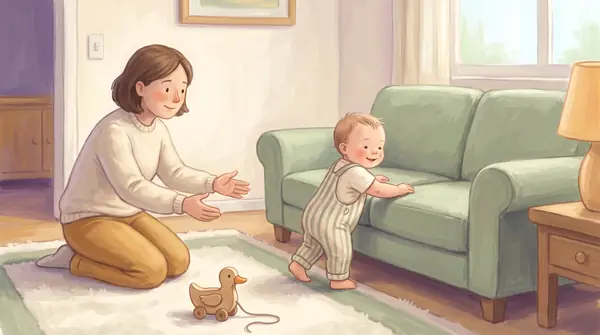
- Moving: This is the walking window for most toddlers, though the normal range is wide — commonly cited anywhere from about 8 to 18 months for first independent steps. Early walking looks distinctive: wide-set legs, arms out for balance, a hesitant, jerky gait that smooths out with practice. Crawling up stairs, standing briefly without holding on, walking backward, and walking up stairs with a hand held are all common in this stretch. By around 18 months, many toddlers can pull a toy along on a string while walking.
- Small-hand skills: By 15-17 months, many toddlers can stack a two-block tower and scribble spontaneously — without needing to watch someone else do it first.
- Everyday skills: Independent eating skills are emerging: holding a cup to drink, using fingers to self-feed, and starting to experiment with a spoon (expect real mess here — it’s part of the learning). Showing affection — hugs, kisses, cuddles, even toward a favorite stuffed animal — is a common milestone around 12-15 months.
- Play and connection: Copying or mimicking what caregivers do and say is a steady thread through this whole year, which is a good reminder that toddlers are always watching and listening, even when they don’t yet have the words to show it.
19 to 24 months
- Talking: This is often called the language explosion — comprehension surges well ahead of speech. By about 21-22 months, many toddlers use at least 50 words, can identify 3-5 named body parts, and understand simple pronouns like me, you, my. Two-word phrases (“more milk,” “go up”) typically show up somewhere in the 16-24 month range and are common by 24 months. Following two-step directions (“get your shoes and bring them here”) is a commonly reached skill around 22-23 months. Expect plenty of mispronunciations (“aminal” for animal, “guck” for truck) and overgeneralizing — calling every woman “mama” or every animal by the family pet’s name — both completely normal parts of sorting new words into categories, not confusion about who’s who. By around 24 months, expressive vocabulary varies a lot from toddler to toddler — many are somewhere in a 50-to-200+ word range — and most speak in 2- to 3-word phrases that often follow a subject-verb-object order like “me want car,” and can be understood by familiar adults roughly half the time.
- Moving: Running, kicking a large ball, standing on tiptoes, climbing on and off low furniture, and jumping with both feet off the ground are common gross motor skills in this window. Squatting during play and attempting to throw or catch a ball also typically show up around 21-23 months. Somewhere around 22-23 months, the early toddling gait usually gives way to a confident heel-to-toe walk. By 24 months, many toddlers can walk up a few stairs — placing both feet on each step before moving to the next — with or without a hand held.
- Small-hand skills: Tower-building climbs from four to six blocks (18-23 months) toward five-plus blocks approaching age 2, and to roughly four blocks reliably by 24 months. A simple 3-piece puzzle is a commonly reached skill around 21-23 months. By 24 months, many toddlers can turn single pages of a book, hold a crayon to scribble, turn doorknobs or lids, sort by shape and color, and drink from an open cup one-handed.
- Emotions and play: Around 20-23 months, a strong sense of “mine!” and difficulty sharing are typical — this is a sign of healthy, developing self-awareness, not a character flaw. Simple pretend play (using a banana as a phone, feeding a stuffed animal) usually starts around 18 months and grows more elaborate by age 2. Many toddlers between about 18-22 months look to a caregiver’s face to figure out how to react to something new or uncertain — a completely normal way of navigating the world through connection.
Sleep at this age
Sleep needs ease gradually across the second year, and the biggest shift is the drop from two naps to one — most toddlers make that move somewhere between 14 and 18 months. Signs a toddler may be ready include suddenly shorter naps, resisting daytime sleep, or reliably sleeping less than 10 hours overnight. It’s worth not rushing the switch: a one-nap schedule generally asks a toddler to stay awake for 5 or more hours at a stretch, and dropping the second nap too soon can leave a toddler pretty worn out by evening.
| Age | Typical total sleep | Notes |
|---|---|---|
| 13 months | About 11-14 hrs, mostly overnight plus 2 naps | Awake stretches typically run 3-4 hrs on a 2-nap schedule |
| 15 months | About 11-14 hrs, overnight plus 1-2 naps | Awake stretches often lengthen to roughly 4-5 hrs |
| 16-18 months | About 11-14 hrs | Molars can unsettle sleep; nap schedule often shifting |
| 19 months | Most are down to one nap | Awake stretches commonly run 5+ hrs between sleep periods |
| 21-23 months | About 11-14 hrs, usually with one nap | Awake stretch before bed often 5+ hrs |
| 24 months | About 11-14 hrs, including one nap | Most toddlers still need a daily nap until around age 3 |
A second wave of molars coming in — commonly around 16 and again around 21 months — can bring some rockier nights and a need for extra comfort; that’s expected and usually temporary. “Nap strikes,” where a toddler suddenly resists a nap around age 2, are often tied to a developmental leap (separation anxiety, potty-training awareness, a longer natural stretch of wakefulness) — the general guidance is to keep offering the nap daily even through a stretch of refusal. Above all, these hour ranges are averages: your toddler’s mood and energy level day to day are a better real-world gauge of whether they’re getting enough sleep than hitting an exact number.
Eating, appetite, and growth
Appetite commonly drops off noticeably after the first birthday — not because anything is wrong, but because growth slows in the second year and a toddler simply needs less fuel than they did as a fast-growing infant. It helps to remember a toddler’s stomach is roughly the size of their own clenched fist, which naturally caps how much they can eat in one sitting. Around 13 months, many toddlers are working on roughly 1,000 calories a day across 3 meals and 2 snacks; general guidance for ages 1-3 works out to about 40 calories per inch of height. By 16-23 months, five small eating occasions a day (3 meals, 2 snacks) is a common rhythm, and many 18-month-olds are still nursing or bottle/breastfeeding alongside an increasingly solid-food diet.
A gradual bottle-to-cup transition is generally recommended somewhere between 12 and 18 months. Water should be the main drink, with milk at about 16 ounces (2 cups) a day, the AAP’s guide for this age — less if a toddler already eats a lot of yogurt or cheese — and milk offered as a drink alongside meals rather than a meal replacement, so solid food stays the main source of nutrition.
Picky eating genuinely is the norm starting around 18 months and can realistically continue until about age 4 — it’s a developmental stage, not a parenting problem. It can take roughly 15 exposures to a new food before a toddler accepts it, so repetition matters more than persuasion. One well-known feeding approach — often called “division of responsibility” — splits the work in two: the adult chooses what food is served, when, and where, and the child chooses whether to eat and how much; this tends to cut down on mealtime power struggles, and one cited study found children actually ate more overall when they weren’t pressured to eat than when they were. Day-to-day eating can look genuinely erratic — a food loved yesterday refused today, a big lunch followed by a picked-at dinner — and that’s expected; intake tends to balance out over the course of a week rather than a single day.
Growth itself slows considerably compared to the first year: toddlers commonly gain around 5 pounds and grow 4-5 inches between 1 and 2 years old, then slow further to roughly 4-6 pounds and 2-3 inches a year between 2 and 3. Head growth also slows while height keeps climbing, which is part of why toddlers start looking more proportionate and less baby-like around their second birthday. A pediatrician tracks height and weight on a growth chart from birth onward specifically to confirm a steady growth pace and flag any trend worth a closer look — not to compare your toddler against anyone else’s.
Big feelings: tantrums and separation anxiety
Temper tantrums are a completely normal, expected part of this age — one cited study found up to 87% of children aged 18-24 months have them. They happen because a toddler’s drive for independence is racing ahead of their communication and self-regulation skills, not because of misbehavior. Tantrums generally continue through the 24-36 month range and tend to ease as verbal skills catch up, commonly around age 4. Mood swings and sudden emotional shifts are common too, as toddlers develop a growing sense of being a separate person from their caregiver.
Separation anxiety commonly shows up or intensifies around 15 or 18 months, and can be more intense when a toddler is hungry, tired, or unwell. A secure attachment is what actually allows a toddler to explore independently, away from a caregiver, during this stretch — while still checking back often for reassurance; that back-and-forth is a sign things are working, not a setback. Parallel play — toddlers playing alongside each other with the same toys, without much direct interaction — is the developmental norm around age 2, with more back-and-forth cooperative play emerging closer to age 3.
Keeping a walking toddler safe and healthy
Around 14 months, once your toddler is on the move, walk through your home again at their eye level. Look for choking hazards, anything poisonous, and breakables they can now reach. Keep the bathroom door shut and the toilet lid closed, and fit a gate at both ends of every staircase, top and bottom. Around 16 months, starting a simple dental routine — a rice-sized smear of toothpaste as part of the bedtime brushing habit — is worthwhile, especially as molars start coming in.
When illness strikes, it’s common for sleep to shift for a few days — more naps, fewer naps, more night waking — and the general approach is to follow your toddler’s cues and ease back into the normal routine once they’ve recovered. A cool-mist humidifier, saline drops, and gentle nasal suction can ease congestion, especially before naps and bedtime. Offering frequent small sips of water or milk helps with hydration if solid-food intake drops during a sick stretch. With a doctor’s go-ahead, infant or children’s acetaminophen or ibuprofen can help with fever or discomfort — but over-the-counter cough and cold medicines aren’t considered safe for young children and are worth avoiding.
When to reach out
- Not standing, even with support
- Not searching for an object hidden while they’re watching
- Not pointing to share interest in something
- Hasn’t picked up simple gestures like waving or shaking the head “no”
- No single words yet — not even “mama” or “dada”
- Around 18-23 months, seems unsure what familiar things like a spoon, a cup, or a comb are for
- Doesn’t imitate others’ actions or words (around 18-23 months)
- Not speaking at least six words (around 18-23 months)
- Doesn’t react when a caregiver leaves or returns (around 18-23 months)
- Not combining any words into two-word phrases by 24 months
- No confident heel-to-toe walking after several months of walking, or walking exclusively on tiptoes (around 22-23 months)
- Very few words, or no new words being added, around 22-23 months
- Losing skills your toddler previously had, at any point
- A fever still going after 24 hours, or one that climbs above 104°F (40°C) again and again
A single item on this list rarely points to a real concern — toddlers develop unevenly, and that’s normal. But if several of these feel familiar, or something just feels off to you, it’s always reasonable to bring it up at the next checkup rather than wait for one — support tends to help most when it starts as soon as a concern is noticed, and a pediatrician would always rather hear about it sooner.
Sources
Written from primary pediatric sources. This is general information, reviewed editorially rather than by a clinician — it isn’t a substitute for your pediatrician’s advice about your child.
- Centers for Disease Control and Prevention — Milestones by 2 Years — Learn the Signs. Act Early.
- Centers for Disease Control and Prevention — CDC's Developmental Milestones — Learn the Signs. Act Early.
- Centers for Disease Control and Prevention — Why Act Early if You're Concerned about Development? — Learn the Signs. Act Early.
- American Academy of Pediatrics (HealthyChildren.org) — Serving Sizes for Toddlers
- American Academy of Pediatrics (HealthyChildren.org) — Discontinuing the Bottle (From Bottle to Cup: Helping Your Child Make a Healthy Transition)
- American Academy of Pediatrics (HealthyChildren.org) — Recommended Drinks for Children Age 5 & Younger
- American Academy of Pediatrics (HealthyChildren.org) — Fever: When to Call the Pediatrician
- American Academy of Pediatrics (HealthyChildren.org) — Acetaminophen Dosing Tables for Fever and Pain in Children
- American Academy of Pediatrics (HealthyChildren.org) — Coughs and Colds: Medicines or Home Remedies? (OTC cough/cold meds not recommended under age 4)
- American Academy of Pediatrics (HealthyChildren.org) — Home Safety: Tips for Families With Young Children
Keep reading
Baby Milestones: 7 to 12 Months
Crawling, cruising, pincer grasp, first words — what tends to happen between 7 and 12 months, and the wide range of normal for each milestone.

Baby Milestones: 1 to 6 Months
Month-by-month milestones from 1 to 6 months — first smiles, rolling, babbling, reaching — with typical ranges and gentle notes on when to check in.

Why Toddlers Fight Sleep: Bedtime Resistance and Stalling
Why toddlers and preschoolers fight bedtime — shifting sleep needs, new independence, real fears — and calm, practical ways to end the nightly standoff.