Starting Solids: Baby-Led Weaning vs. Purees
Baby-led weaning and purees are simply two different roads to the same destination — a baby who eats a wide variety of foods by their first birthday — and neither one is medically "better" than the other.

What baby-led weaning actually is
Baby-led weaning, often shortened to BLW, is an approach to starting solids built around infant self-feeding. Instead of a caregiver loading a spoon with puree, the baby is offered soft, appropriately sized pieces of family food and allowed to pick it up, explore it, and feed themselves from the very first meal. The term was popularized in a 2009 book, with the concept itself credited as emerging around 2005, and it has since become one of the two dominant starting-solids approaches alongside traditional purees.
The word “weaning” trips a lot of parents up. In this context it doesn’t mean cutting back breastmilk or formula — quite the opposite. Whether you choose BLW, purees, or a mix of both, solid food at this stage is meant to complement milk feeds, not replace them. Until roughly the first birthday, most of your baby’s nutrition still comes from breastmilk or formula, and you shouldn’t reduce milk or formula feeds just because solids have started. Babies naturally taper their milk intake on their own as solid food intake grows — you don’t need to manage that trade-off yourself.
When to start, and how to know your baby is ready
Most guidance points to around 6 months of age as the right window to start solids, whichever method you choose. That timing gives your baby’s digestive and immune systems more time to mature before taking on new foods. A few signs tend to show up together when a baby is ready:
- Eyeing your plate and reaching toward what you’re eating
- Putting toys and other objects up to the mouth
- No longer using the tongue-thrust reflex (the automatic push-food-back-out reaction of early infancy)
- Steady head and neck, and sitting up without help
If you’re specifically considering purees, one more sign is often cited: your baby has roughly doubled their birth weight. And on timing, there’s an important floor — purees should not be started before 4 months of age, since introducing solids too early has been associated with increased risk. If you’re ever unsure whether your baby is ready, it’s worth checking in with your pediatrician before diving in — every baby’s timeline looks a little different.
Setting up safely, no matter which method you choose
The single most important piece of equipment for either approach isn’t a blender or a special spoon — it’s a proper highchair setup. Your baby should be seated upright with a straight back (not reclined), well supported, with their arms and hands free to reach food. You should sit facing your baby and stay within arm’s reach the entire meal. Babies should never be left alone while eating, and never left alone seated in a highchair at any time. This one habit does more for mealtime safety than any specific food choice.
How baby-led weaning works, step by step
At the start, around 6 months, expect one solid “meal” a day, and expect your baby to eat very little of it. Touching, tasting, squishing, and spitting food back out are all normal and valuable at this stage — they’re how your baby learns what food is, long before they’re eating meaningful volumes.
Food should always be prepared soft enough to squish easily between two fingers. Early pieces are usually cut into strips about the size of your pinky finger, long enough for a baby to grip in a fist with some sticking out the top — this lets them self-feed even before they have a refined pincer grasp. As hand and finger skills develop, pieces can shrink to smaller diced sizes.
A rough meal-frequency progression looks like this:
| Age | Meals per day |
|---|---|
| ~6 months | 1 solid meal |
| ~7-9 months | 2 meals |
| ~9-12+ months | ~3 meals, plus 2 snacks by 12 months |
By around 9 months, most babies following BLW are comfortably eating soft table foods and finger-feeding.
How purees work, step by step
Purees follow a similar meal-frequency arc but a different texture path. Rather than starting with whole pieces, food is blended completely smooth first. From there, texture advances in stages: fully smooth purees, then purees with some lumps or a mashed consistency, then small soft pieces, gradually working toward soft table foods by around 9 months — the same finish line as BLW, just reached from spoon-feeding rather than self-feeding.
Store-bought purees are often labeled by these same stages: “first foods” (single ingredient, very smooth), “second foods” (two or more ingredients, a bit thicker), and “third foods” (food combinations that call for some chewing). If you’re using jarred or pouched purees, these labels are a handy shortcut for matching texture to your baby’s stage.
One thing worth knowing: if a baby stays on a single smooth texture for too long without being nudged forward, they can have a harder time accepting more advanced textures later. Advancing texture on a reasonably steady timeline — rather than lingering at smooth for months — helps avoid that.
Gagging vs. choking — the difference that matters
This is worth learning before your baby’s first bite, regardless of method. Gagging is a normal, protective reflex. It looks and sounds alarming — your baby may cough, retch, their eyes may water, their face may turn red — but air is still getting through, and your baby is busy shifting the food somewhere safer or swallowing it. It usually resolves on its own and doesn’t need you to intervene.
True choking is different: the airway is blocked, the baby cannot dislodge the food on their own, and they need you to step in. It’s genuinely worth learning infant choking response (many pediatricians’ offices or community programs offer a short class) before you start solids, so you can tell the two apart calmly in the moment rather than guessing.
Encouragingly, the research on this specific worry is reassuring: a randomized controlled trial and other studies have found that baby-led weaning, when practiced with proper food modification — soft textures, safe shapes, appropriate supervision — does not carry a higher choking risk than traditional spoon-feeding.
Foods to avoid at this stage
A handful of foods and shapes carry a real choking risk for babies and toddlers and are worth avoiding regardless of which method you use:
- Whole nuts; nut butter should always be spread thin or mixed into another food, never served as a thick glob
- Hot dogs sliced into coins or rounds
- Popcorn, chips and other hard snacks that crunch
- Uncooked carrots and other raw or firm vegetables
- Cherry tomatoes and whole grapes, unless quartered lengthwise
- Tough meat served in chunks
- Honey before the first birthday, because of the risk of infant botulism
The general safe-prep rule covers most situations: cook food until it’s soft enough to squish between your fingers, avoid small round shapes, and cut food into finger-sized sticks or strips that are easy for a baby to grip.
Introducing allergens safely
Current guidance actually supports introducing the top allergen foods around the same time solids typically start — 6 months — rather than delaying them. The reasoning is that early, then continued, exposure appears to help rather than hurt. Most food allergies trace back to nine foods: peanuts, egg, cow’s milk, sesame, tree nuts, soy, wheat, shellfish, and fish.
A few practical habits make this easier to do safely: introduce one new allergen at a time, watch for a few days before adding another, and offer high-risk allergen foods earlier in the day rather than at night, so you’re awake and watching if a reaction shows up. Most allergic reactions appear quickly — within minutes to a few hours — though some can also show up after a food has already been tolerated once, so it’s worth staying attentive across the first several exposures, not just the very first one.
Nutrition essentials: iron, protein, and fat
Around 6 months, a baby’s nutritional needs shift in a specific way: they’re growing quickly, and their need for iron, protein, and fat rises. This is true whichever feeding method you’re using.
- Iron supports oxygen transport and brain development. Good sources include soft-cooked beef or pork, poultry, eggs, beans, lentils, tofu, and fortified infant cereal. Iron absorbs better when paired with a vitamin-C food in the same meal — citrus, strawberries, kiwi, tomato, or dark leafy greens.
- Protein supports growth, tissue building, and immune function. Sources include meat, poultry, fish, eggs, beans, lentils, tofu, cheese, yogurt, thinly spread nut butter, and whole grains.
- Fat, including omega-3s, supports energy needs and brain and nervous-system development and shouldn’t be restricted in an infant’s diet. Sources include avocado, fish, full-fat yogurt or cheese, olive oil, butter, nut butter, chia seeds, and ground flaxseed.
For fruits and vegetables, good early options — cooked soft for either method — include carrots, broccoli, butternut squash, cauliflower, zucchini, sweet potato, potato, cucumber, very ripe plum, peach, pear, or mango, kiwi, avocado, banana, and berries.
A note on heavy metals in baby food
Studies have raised concern about heavy metals, like arsenic, in some commercial baby foods, including rice-based products. Certain crops, especially rice and root vegetables, naturally draw heavy metals up from soil, and that can’t be fully avoided. A few simple habits reduce exposure: limit rice-based products, choose grain products made from grains other than rice (oats are a good swap), lean toward homemade whole-ingredient snacks over prepackaged ones, and rotate through a variety of fruits and vegetables rather than repeating the same one often. Fruit juice isn’t recommended for babies either, even as a way to offer fruit.
Weighing the two approaches
Neither method has a clear medical edge, but each has genuine trade-offs worth knowing going in.
Baby-led weaning tends to bring:
- Early contact with many different tastes and textures, which is tied to a better-quality diet later on and may reduce picky eating in toddlerhood
- Practice with gross and fine motor skills — grasping, hand-eye coordination, arm and hand strength — through repeated self-feeding
- Reports from some mothers of less mealtime stress and a simpler, more convenient routine
- Time and cost savings, since the baby largely eats modified family meals rather than separately prepared baby food
- A downside worth planning for: real mess, since exploring and playing with food is part of how babies learn to self-feed
- Less precision in knowing exactly how much your baby has eaten, since much of the food ends up on the floor or highchair rather than in their mouth, especially early on
- The need to still keep a modified or separate item on hand sometimes, since not everything on the family table (fast food, high-salt or high-sugar dishes) is appropriate for a baby
Purees tend to bring:
- Easier tracking of exact intake — spoonfuls or jar amounts — which can be reassuring if you’re watching how much your baby is eating
- Less mess and less food waste, especially in the early months
- Familiarity for grandparents or childcare providers, which can make it easier to line up support from other caregivers
- Cost that adds up if you rely on commercial purees, though homemade purees save money at the cost of more prep time
- A tendency to delay self-feeding motor practice until later in the process, compared to BLW
- Babies sometimes eating separately, before or after the family meal, which can make it harder (though not impossible) to fold them into shared mealtime
Combination feeding: the best of both
You don’t have to pick one lane and stay in it. Combination feeding — offering purees and BLW-style table food at the same meal, or alternating which method you use across meals or days — is a common and entirely valid approach. It can be especially useful for easing childcare transitions, since a baby who’s used to both styles adapts more easily across different caregivers and settings. The main trade-off is that managing two feeding styles can be more time-consuming or messier, and occasionally a baby with a strong preference for one method may resist the other.
Moving from purees toward table foods
Even a puree-first baby is headed toward the same place — soft table foods by around 9 months. A gentle way to bridge the two: start slowly by offering purees and table foods at the same meals, or alternating between them. Let your baby practice self-feeding purees, for example by loading a spoon and letting them bring it to their own mouth. And when you do introduce table foods, keep them prepared to the same safety standard as BLW — soft enough to press flat with a thumb and fingertip.
There’s no single right answer
Both baby-led weaning and purees can support healthy growth and development when practiced safely and responsively. The right choice comes down to your family’s circumstances, your own comfort level, and your baby’s individual preferences — some babies take to self-feeding immediately, others do better warming up with a spoon first. And your choice isn’t permanent. Families adjust, switch, or blend methods all the time as needs change. If mealtime lands right when your baby is sleepy — say, close to a nap — it’s often more practical to offer breastmilk or formula instead of pushing through a solids meal; solids are still the supplementary player at this stage, not the main event.
When to reach out
- Signs of an allergic reaction — skin rash, hives, vomiting, or diarrhea after a new food — warrant a call to your child’s healthcare provider; if you’re unsure, a call is always a reasonable choice
- If your baby ever shows signs of true choking — a blocked airway, unable to cough, cry, or breathe, and unable to clear the food on their own — this needs immediate caregiver intervention; learning infant choking response before starting solids is strongly worthwhile
- If you’re unsure whether your baby is showing genuine readiness signs for solids, or you want guidance on timing given your baby’s specific health history, check with your pediatrician before starting
- Any concern about persistent feeding difficulty, refusal, or a reaction you can’t explain is worth raising with your pediatrician rather than waiting it out
Sources
Written from primary pediatric sources. This is general information, reviewed editorially rather than by a clinician — it isn’t a substitute for your pediatrician’s advice about your child.
- CDC — When, What, and How to Introduce Solid Foods — Infant and Toddler Nutrition
- Centers for Disease Control and Prevention — Choking Hazards - Infant and Toddler Nutrition
- CDC — Tips for Mealtime Routines — Infant and Toddler Nutrition
- American Academy of Pediatrics (HealthyChildren.org) — Starting Solid Foods
- American Academy of Pediatrics — When to Introduce Egg, Peanut Butter & Other Common Food Allergens to Your Baby — HealthyChildren.or
- American Academy of Pediatrics — AAP Clinical Report Highlights Early Introduction of Peanut-based Foods to Prevent Allergies
- U.S. Food and Drug Administration — Food Allergies / FASTER Act: Sesame is the Ninth Major Food Allergen
- Cleveland Clinic — Why Honey Isn't Safe for Babies (and When It Is)
- American Academy of Pediatrics (Pediatrics) — A Baby-Led Approach to Eating Solids and Risk of Choking (BLISS RCT, Fangupo et al., 2016)
Keep reading
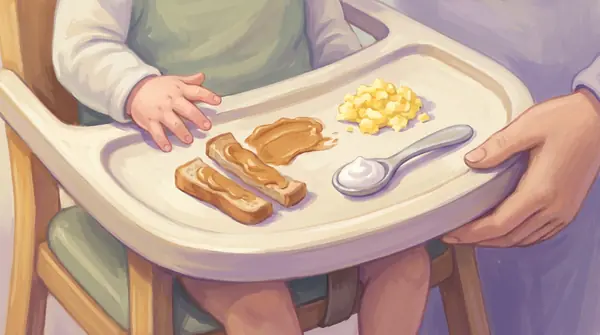
Introducing Allergens to Your Baby: Peanut, Egg, and More
Early, regular exposure to peanut, egg, and other top allergens is now the recommended approach for most babies. How to introduce each one safely.
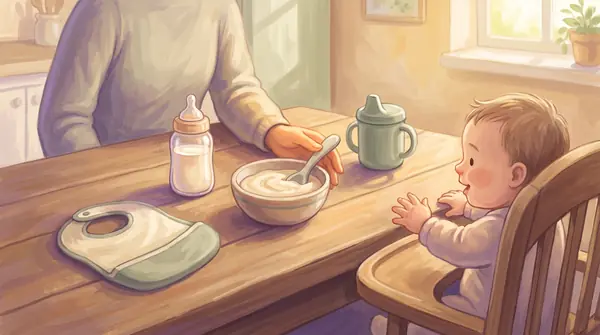
Baby Feeding Schedules by Age: Birth to 12 Months
Sample feeding schedules from newborn to 12 months: how often, how much, and when solids change the rhythm — with cues that matter more than the clock.

Baby Milestones: 7 to 12 Months
Crawling, cruising, pincer grasp, first words — what tends to happen between 7 and 12 months, and the wide range of normal for each milestone.