Safe Sleep for Babies: Crib Setup, Position, and Temperature
A safe sleep space comes down to a handful of consistent choices — a bare, firm crib, back-sleeping every time, and a comfortably cool room — not a long list of special products.

Safe sleep reminder: Always place baby on their back to sleep, on a firm, flat sleep surface in their own crib, bassinet, or play yard, with a fitted sheet only and no loose blankets, pillows, bumpers, stuffed animals, or other soft items.
What “safe sleep” actually means
Safe sleep is really two things working together: the physical space your baby sleeps in, and the conditions you set up inside it. A great crib doesn’t do much good if it’s filled with soft bedding, and the right sleep position doesn’t do much good on an unsafe mattress. According to the AAP’s Task Force on SIDS, your baby’s sleep space — a crib, a bassinet, a portable crib, or a play yard — should meet Consumer Product Safety Commission (CPSC) safety standards. That single requirement is the foundation everything else in this guide builds on.
Sleep environment, at a glance
A lot of what “safe sleep” looks like shifts as your baby grows. Here’s the shape of it over the first couple of years:
| Age or stage | What changes |
|---|---|
| Birth | Room-share in your baby’s own crib or bassinet; back-sleeping every time; sleep sack or swaddle |
| First 2 months | The “newborn scrunch” reflex is common and isn’t a sign of rolling |
| ~2–4 months | Stop swaddling as soon as early rolling signs appear |
| ~4–7 months | Most babies can roll both directions; once that’s reliable, let them settle wherever they land |
| Before baby can sit up | Lower the crib mattress one notch |
| Before baby can stand | Lower it again |
| First 6 months, at least | The AAP’s room-sharing recommendation; many families keep going longer |
| 12 months | Earliest point to consider retiring the sleep sack |
| ~35 inches tall | Time to transition out of the crib |
Choosing a crib that meets today’s standards
Not every crib sitting in a garage or passed down between family members is still safe to use. As a general rule, avoid any crib older than about 10 years, and specifically avoid one manufactured before 2011 — that’s when updated federal crib safety standards took effect. A crib that’s broken, has been modified, or uses an old drop-side design should never be used, and a broken crib should never be field-repaired and put back into service.
A few structural details are worth checking by hand:
- Slats should be spaced no more than 2⅜ inches apart, so a baby’s body can’t slip through
- Any missing, cracked, loose, or improperly installed hardware or slats means the crib shouldn’t be used
- Corner posts should sit essentially flush with the rail (no more than about 1/16 inch proud) or be very tall, like a canopy bed, so clothing can’t snag on them
- Headboards and footboards with decorative cutouts should be avoided, since they can trap a baby’s head or limbs
The mattress and what belongs inside the crib
The mattress itself should be firm and flat — inclines greater than about 10 degrees are considered unsafe, and nothing should ever be wedged underneath to tilt it. It should also fit snugly against the frame. A simple way to check, sometimes called the two-finger test: if more than two adult fingers fit between the mattress edge and the crib side, that gap is large enough to be an entrapment risk.
Crib bumper pads are not recommended. They raise the risk of suffocation, strangulation, and entrapment, and can even give a climbing toddler a boost up and out — part of why the Safe Sleep for Babies Act of 2021 bans their sale nationally. Beyond the mattress and a fitted sheet, the crib should stay completely bare: no pillows, loose blankets, quilts, comforters, sheepskins, mattress toppers, or stuffed toys. For a baby under 12 months, all of these are suffocation hazards, however soft and harmless they look.
Adjusting the crib as your baby grows
A crib isn’t a “set it once” purchase. Lower the mattress before your baby can sit up on their own, so they can’t tip themselves out, and lower it again before they can pull to stand. Plan to move your baby out of the crib entirely around 35 inches tall, since a taller toddler is at real risk of a climbing-related fall.
Where the crib sits matters too. Cords and strings — from window blinds, drapes, or a baby monitor — are a strangulation hazard, so keep the crib away from windows with corded coverings; cordless coverings are the safer choice where you have one. The same babyproofing applies to a room-shared sleep space: no dangling cords nearby, and anything hung above the crib, like a mobile, should be anchored to the wall or ceiling — never to the crib itself.
The safest sleep position: back, every time
For babies under 12 months, the single safest sleep position is flat on their back, for every sleep, on a firm flat surface. This recommendation alone has been tied to a substantial shift in outcomes: since campaigns promoting back-sleeping began in the early 1990s, U.S. SIDS rates have fallen by more than half.
SIDS — sudden infant death syndrome, sometimes grouped under the broader term SUID (sudden unexpected infant death) — describes the unexplained death of a baby younger than one. Researchers believe it may be linked, at least in part, to a reduced ability in some babies to rouse or wake themselves when something is wrong, like a dip in oxygen. It’s rare, and the steps in this guide reflect the best current understanding of how to lower the risk.
Rolling, repositioning, and the “newborn scrunch”
Most babies develop the ability to roll both directions — back to tummy and tummy to back — somewhere around 4 to 7 months, though initial rolling can start as early as 2 months. Once your baby can reliably roll both ways on their own, it’s fine to let them stay in whatever position they roll into during sleep, though you should still place them on their back to start each sleep. Until that reliable rolling is in place, if you find your baby on their stomach or side, gently reposition them onto their back.
In the first couple of months, you may notice your baby curling onto their side moments after you lay them down flat. This “newborn scrunch” is an involuntary, comfort-seeking reflex — a holdover from the womb — not a sign of rolling. You can simply reposition them onto their back.
Side- or stomach-sleeping before a baby can roll both ways independently carries real risk. It’s linked to a higher chance of SIDS, and it also raises choking risk if a baby spits up: face-down or on the side, gravity lets any regurgitated fluid pool near the airway, while back-sleeping keeps the airway positioned above the esophagus. Stomach sleeping is also linked to a higher risk of overheating, since a baby who can’t yet reposition may get stuck against warm bedding — and overheating is itself an independent SIDS risk factor. Back-sleeping, by contrast, is linked to a lower infant body temperature.
One practical note tied to rolling: as soon as your baby shows signs of being close to it — rocking side-to-side, lifting their legs, twisting their torso — stop swaddling right away, so their arms are free to help them reposition if needed.
Products to skip for sleep
A number of popular baby products aren’t considered safe for a baby’s regular sleep spot, even though they’re widely sold and marketed for naps:
- Sleep positioners
- Inclined sleepers
- Baby loungers, docks, or pods
- Sleep wedges
- Swings, car seats, or other carriers used as a stand-in crib
Positioners carry a suffocation risk if a baby’s face presses into the padding, and inclined products can force a chin-to-chest position that restricts breathing. This is part of why the Safe Sleep for Babies Act of 2021 — the same law that bans crib bumpers — also bans the sale of inclined sleep products. (A car seat is still the right, safe place for your baby during actual car travel — the caution here is about using one as a regular stand-in for a crib or bassinet at home.)
Weighted sleep products are worth calling out separately: weighted blankets, swaddles, sleepers, and sleep sacks aren’t recommended for infants either. The added weight may restrict a baby’s movement or make it harder for them to reposition or rouse if something’s wrong.
A small habit that helps: pacifiers
One simple, well-supported choice: when your baby goes down for a nap or for the night, offer a pacifier. That habit is linked with lower SIDS risk. If your baby isn’t interested, or it falls out once they’re asleep, there’s no need to pop it back in.
Room sharing: nearby, not sharing a sleep surface
The AAP recommends room sharing — your baby’s own crib or bassinet within arm’s reach of your bed, same room but not the same sleep surface — from birth for at least the first six months. Set up this way, room sharing is associated with up to a 50% reduction in SIDS risk. It also tends to make nighttime breastfeeding logistically easier, which is itself a separate protective factor against SIDS, and one 2019 study linked room sharing to more positive behavioral outcomes later in middle childhood.
Six months is a floor, not a finish line: the AAP recommends room sharing for at least the first six months, and when to move your baby into their own room after that is a family decision. If you’re weighing the timing, your pediatrician is a good person to talk it through with.
A few other things are worth knowing if you’re room sharing. After the newborn stage, a parent’s ongoing presence nearby — snoring, coughing, shifting in bed — is commonly associated with more fragmented baby sleep and more frequent waking, since a stirring baby who senses a nearby parent may have a harder time settling back down on their own. That’s ordinary, not a problem to fix. It’s also entirely typical for babies to briefly wake several times a night through their first year without calling out, and many babies aren’t consistently able to fall back asleep independently until around 5 to 6 months old. If you’re working on sleep training while room sharing, expect it to move more slowly, since your baby can see, hear, and sense you nearby during night wakings; some families temporarily sleep in another room for a stretch to help things along.
Bed sharing: the guidance, and what if you do it anyway
AAP guidance advises against bed sharing — a baby sleeping in the same adult bed — because of the higher associated risk of SIDS and suffocation. That said, many families do choose to bed-share, sometimes only later in the night, often after a feeding, after starting the night in a separate sleep space. One thing holds true either way: it is more dangerous for a caregiver to fall asleep with a baby on a sofa or armchair than in an adult bed, so a baby should never be left sleeping on either.
For families who choose to bed-share, commonly cited harm-reduction steps — sometimes called the “Safe Sleep Seven” — include:
- Every adult in the bed is sober and a non-smoker
- Baby is full-term and healthy
- Baby is placed on their back, lightly dressed, and unswaddled
- The surface is firm and flat, free of pillows, heavy blankets, and other soft items
- Bed-sharing never happens on a sofa or armchair
Room temperature: keeping things comfortably cool
A commonly cited comfortable range for a baby’s sleep space is about 68–72°F (20–22°C) — a widely used guideline from pediatric sleep-health research, though no single number fits every home exactly. It matters because babies, newborns especially, can’t regulate their own body temperature as efficiently as adults, and overheating is a well-established SIDS risk factor.
To judge whether your baby is too warm or too cold, check the back of their neck or their chest rather than their hands or feet, which are normally cooler and aren’t a reliable indicator. Signs your baby may be too warm include flushed cheeks, a sweaty neck or hairline, a hot chest or back, restlessness, and rapid breathing. Signs they may be too cold include a cool chest, neck, or back, pale or bluish skin, rare shivering, and more frequent waking at night.
Dressing your baby for sleep
Sleep sacks and swaddles are often labeled with a TOG (Thermal Overall Grade) rating that tells you how warm the fabric is:
| Room feels | Typical TOG rating |
|---|---|
| Warm | About 0.5 TOG |
| Mild to moderate | About 1.0 TOG |
| Cool | About 2.5 TOG |
| Cold | About 3.5 TOG |
Beyond the label, a simple rule of thumb works well: dress your baby in roughly the same number of layers you’d wear yourself to sleep comfortably in that room, maybe one extra — and resist the urge to over-bundle, since overheating is a risk factor to manage, not a margin of safety to add.
Newborns lose body heat quickly, since they have more skin surface area relative to their size and burn through energy reserves trying to stay warm — part of why skin-to-skin contact is one of the most effective ways to help stabilize a newborn’s temperature. Babies born prematurely may need extra help regulating their temperature and benefit from individualized guidance from their own medical provider on dressing and warmth.
One more sign worth watching for: heat rash, which shows up as small red bumps, often on the neck, chest, or back, can signal your baby is dressed too warmly. It’s worth a doctor’s attention if it worsens or comes with fever or signs of infection like pus or blisters.
Sleep sacks: the safer stand-in for a blanket
Loose blankets aren’t recommended for babies under 12 months, since they can shift during sleep and cover the face or airway. A wearable blanket, or sleep sack, is the safer substitute for warmth. A properly fitted one has a snug — not tight — neckline and armholes, while staying roomy enough through the body for kicking and healthy hip movement.
You can use a sleep sack from birth, though many parents swaddle newborns for sleep instead before moving to a sack later on. Standard sleep sacks typically fit up to about 36 pounds or 40 inches, which covers most children to roughly age 2; toddler-style sacks with pant legs extend sizing up to about size 5T for families who want to keep using one longer. It’s recommended to keep using a sleep sack instead of a loose blanket until at least 12 months old, and to keep going as long as it fits well and your child is comfortable in it.
Making the swaddle-to-sack transition
Once you notice those rolling signs — or by around 3 to 4 months for many babies, sometimes as early as 2 months — it’s time to retire the swaddle for good. Some families switch immediately once rolling starts, or once their baby is reliably breaking free of the swaddle anyway. Others prefer a more gradual transition: one arm out for a few nights, then both arms out, then a full switch to a sleep sack. Either way, it’s common for a baby to wake more often for a stretch right after the swaddle comes off — that settles back down as they adjust to the new feeling.
Fans, blackout curtains, and the rest of the room
A ceiling or portable fan can help reduce overheating risk by improving air circulation. If you use one, keep any cords out of reach, and position the fan so it never blows directly on your baby or sits inside or right next to the crib.
Blackout curtains, blinds, or shades do double duty: they cut down on sun-driven heat buildup in the room, and when they fully cover the window edges — dark enough that you couldn’t read a book by any light leaking around them — they also reinforce the darkness cues that support longer, more consolidated naps and less early-morning waking.
White noise and sound machines
If you use a sound machine, place it at least 7 feet (about 200 cm) from your baby’s sleep space, keep the volume below maximum, and aim for no louder than about 50 decibels — roughly as loud as a quiet dishwasher or moderate rainfall. This isn’t a small margin of caution: a 2014 study found that infant sleep machines commonly exceed hospital-recommended noise levels at maximum volume, and the AAP reiterated this same distance-and-volume guidance in a 2023 policy statement on noise exposure in children.
White noise is thought to help babies settle for a few reasons: it may echo the loud ambient sound environment of the womb (older research put this at around 90 decibels, similar to a lawnmower — part of why the machine itself still needs to stay much quieter than that for safety), it can mask everyday household sounds like a door closing or a nearby conversation, and it can serve as a consistent cue within a bedtime routine. A small 1990 study found about 80% of very young newborns fell asleep within 5 minutes of white noise exposure, and a small 2018 study found colicky newborns cried less and slept more with white noise than when soothed by swinging — interesting findings, though both come from small, limited studies. Claims that white noise reduces SIDS risk specifically are unproven and would need more current research to support them.
A couple of downsides are worth keeping in mind: possible hearing effects if a machine runs too loud or too close, and a baby becoming dependent on white noise to fall asleep, which can complicate travel or daycare settings where it isn’t available. If you’re choosing between white noise and pink noise — the kind found in nature, like rain, wind, waves, or rustling leaves — know that pink noise has less variation across frequencies. White noise may do a better job masking sudden loud sounds like a door slamming or thunder, while pink noise may do better at masking steady background sound like voices or a distant TV.
If you ever use a phone as a sound source, never place it inside the crib or sleep space itself, and if it’s left in the nursery, set it to airplane mode with notifications silenced.
Light, darkness, and your baby’s internal clock
Melatonin, the hormone that helps regulate the body’s sleep-wake rhythm, typically isn’t produced or released by babies until around 3 months of age — part of why very young newborns don’t yet have a strong day/night rhythm of their own. Bright daylight exposure during awake periods in the early weeks helps reinforce that distinction as it develops, and once the newborn day/night confusion phase resolves — typically by around 8 weeks — most babies nap and sleep more soundly in a darkened room.
If you use a nightlight, warm, dim light in red or amber tones is the most sleep-friendly choice. Cooler blue-toned and bright white or green-leaning light suppresses melatonin more strongly, especially in the evening, and light from screens and LEDs has the most potent effect — part of why the AAP recommends avoiding screens for at least 60 minutes before a child’s bedtime routine begins. Keep any nightlight as dim as possible, just enough for safe movement during nighttime feeds or diaper changes, and position it low and away from the crib or bassinet to limit direct light reaching your baby’s eyes.
Tummy time, for awake and supervised moments
Tummy time doesn’t happen during sleep, but it supports safe sleep in a real way: supervised tummy time helps babies build the strength they need to roll both directions, which is what eventually makes it safe for them to settle into a side or stomach position on their own. It also helps prevent flat spots from extended time on the back. A common guideline is to start from birth and build gradually toward about 15 to 30 minutes a day, in short sessions, by around 7 weeks to 2 months old.
Very few babies have a specific medical reason to sleep on their stomach. If you have individual concerns about your baby’s sleep position, your pediatrician is the right person to talk it through with.
When to reach out
- Your baby is breathing faster than about 60 breaths per minute, or their skin has a bluish tint — call your pediatrician
- Warming your baby doesn’t help quickly, or they seem lethargic or hard to wake — seek medical attention right away
- Heat rash that worsens, or comes with fever, pus, or blisters — have your doctor take a look
- You have individual concerns about your baby’s sleep position, or a possible medical reason for stomach-sleeping — talk it through with your pediatrician
Sources
Written from primary pediatric sources. This is general information, reviewed editorially rather than by a clinician — it isn’t a substitute for your pediatrician’s advice about your child.
- American Academy of Pediatrics — Sleep-Related Infant Deaths
- American Academy of Pediatrics — How to Keep Your Sleeping Baby Safe: AAP Policy Explained (HealthyChildren.org)
- American Academy of Pediatrics — Preventing SIDS (HealthyChildren.org)
- U.S. Consumer Product Safety Commission — Crib Safety Tips
- U.S. Consumer Product Safety Commission — CPSC Approves Strong New Crib Safety Standards To Ensure a Safe Sleep for Babies and Toddlers
- U.S. Consumer Product Safety Commission — Safe Sleep for Babies Act Business Guidance (crib bumper & inclined-sleeper ban)
- U.S. Congress (Library of Congress) — H.R.3182 — Safe Sleep for Babies Act of 2021 (signed into law May 16, 2022)
- National Institute of Child Health and Human Development (NIH) — Safe to Sleep — About Back Sleeping (arousal, aspiration anatomy, rolling/repositioning, stomach-sleep overheating)
- National Institute of Child Health and Human Development (NIH) — SIDS: Research Activities and Advances — Back to Sleep / Safe to Sleep campaign impact
- American Academy of Pediatrics — Preventing Excessive Noise Exposure in Infants, Children
- American Academy of Pediatrics (Pediatrics) — Hugh SC, et al. Infant Sleep Machines and Hazardous Sound Pressure Levels. Pediatrics. 2014;133(4)
- La Leche League International — The Safe Sleep Seven
- National Sleep Foundation — The Best Room Temperature for a Sleeping Baby (68–72°F consensus figure)
- Cleveland Clinic — Tachypnea (Rapid Breathing) — infant respiratory rate >60/min
Keep reading
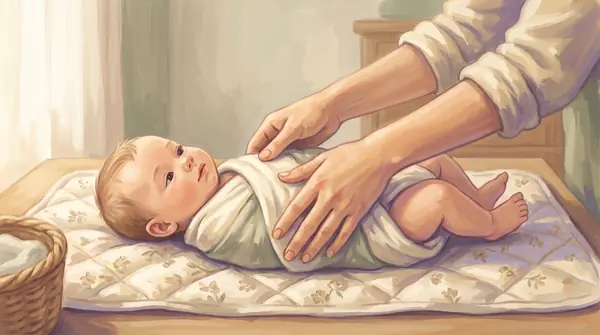
How to Swaddle a Baby: Technique, Safety, and When to Stop
Swaddling can be a genuinely helpful sleep tool for many newborns, but it comes with real technique and timing rules worth knowing before you start.
Contact Napping: When It's Okay and How to Transition
Contact napping is normal and often valuable. When it's safe, when it works for your family, and how to move naps to the crib gently when you're ready.
Newborn Sleep Schedule: Birth to 12 Weeks
Newborn sleep runs on hunger and wake windows, not the clock. What a typical day looks like from birth to 12 weeks — and what not to worry about.